
𝗪𝗵𝗲𝗻 𝘁𝗵𝗲 𝗖𝗿𝗶𝘀𝗶𝘀 𝗛𝗶𝘁𝘀, 𝗧𝗵𝗲𝗿𝗲 𝗜𝘀 𝗡𝗼 𝗧𝗶𝗺𝗲 𝘁𝗼 𝗟𝗲𝗮𝗿𝗻
In today’s operating environment, uncertainty is the only certainty. To bring clarity in the chaos, organisations invest heavily in AI, dashboards, and tools for predictive intelligence and rightly so. But the hard truth is most of the crises cannot be forecast or foreseen. They erupt suddenly, without warning, such as industrial accidents, security incidents, cyber disruptions, reputational flashpoints, geopolitical spill overs. When they do, the luxury of time disappears.
What follows is a compressed decision window, intense pressure, incomplete information, and the urgent need for cross-functional coordination transcending operations, security, legal, HR, communications, leadership all at once. In such moments, performance does not depend on intelligence or intent. It depends on preparedness.
𝗪𝗵𝘆 𝗣𝗲𝗿𝗶𝗼𝗱𝗶𝗰𝗮𝗹 𝗖𝗠𝗧 𝗘𝘅𝗲𝗿𝗰𝗶𝘀𝗲𝘀 𝗔𝗿𝗲 𝗡𝗼𝗻-𝗡𝗲𝗴𝗼𝘁𝗶𝗮𝗯𝗹𝗲
Most crises in India or elsewhere don’t arrive as black swans. They unfold on ordinary workdays; during a shift change, a festival week, a system upgrade, or a routine monsoon and escalate faster than approvals can move.
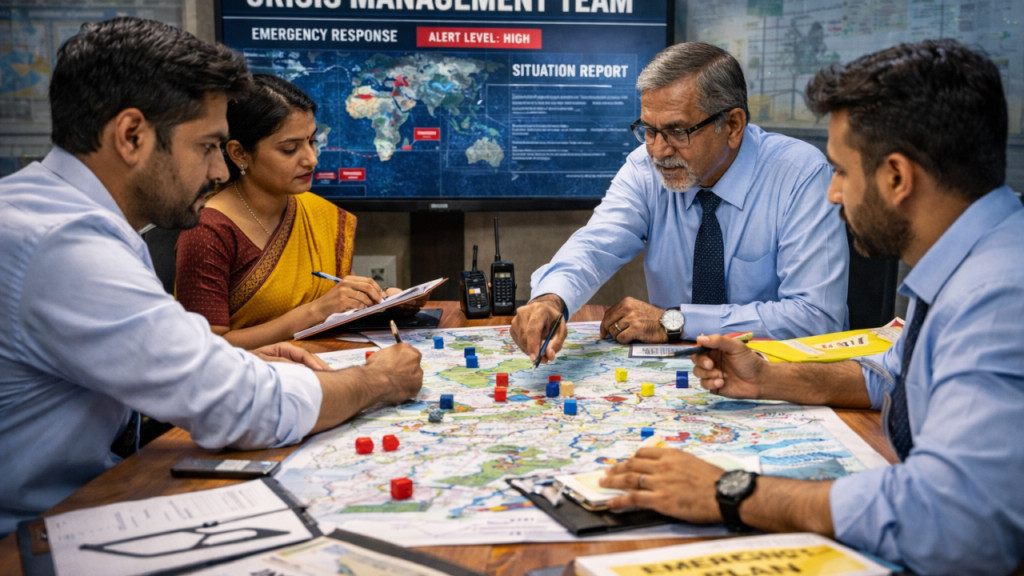
In such moments, Crisis Management Team (CMT) exercises separate organisations that respond with clarity from those that react in confusion. When designed and conducted well, they become true organisational survival tools.
Effective CMT exercises enable organisations to test how decisions are actually made under pressure and ambiguity, not how they are assumed to be made on paper. They help validate whether escalation protocols and decision authority work in real time, while revealing coordination gaps that often exist across functions. By repeatedly exposing teams to simulated stress, these exercises reduce hesitation, confusion, and role overlap, ensuring that everyone knows their part when it matters most. Above all, they prepare leaders to act decisively in those critical moments when minutes not intentions determine outcomes.
Most importantly, they prepare teams for what no algorithm can simulate in real time: human stress, ambiguity, and consequences.
𝗙𝗿𝗼𝗺 𝗜𝗻𝘀𝘁𝗶𝘁𝘂𝘁𝗶𝗼𝗻𝗮𝗹 𝗠𝗲𝗺𝗼𝗿𝘆 𝘁𝗼 𝗠𝘂𝘀𝗰𝗹𝗲 𝗠𝗲𝗺𝗼𝗿𝘆
Policies and playbooks build institutional memory, they tell you what should be done and at the same time exercises and drills build muscle memory, they ensure people actually do it when it counts.
Under stress, teams do not rise to the occasion; they fall back to their level of training. Repeated tabletop exercises and simulations build the confidence and role clarity needed to eliminate decision delays and enable faster, more aligned responses. By rehearsing complex scenarios in advance, organisations reduce the risk of hesitation and misalignment, preventing avoidable escalation of harm when real incidents unfold.
In an actual crisis, this preparedness can make the decisive difference between containment and catastrophe, control and chaos, reputations protected or permanently damaged, and, in some cases, lives saved.
𝗛𝗼𝘄 𝗣𝗿𝗼𝗦𝗲𝗰𝘂𝗿𝗲 𝗔𝗱𝗱𝘀 𝗩𝗮𝗹𝘂𝗲:
Internal crisis exercises often carry inherent blind spots shaped by hierarchy, familiarity, assumptions, and confirmation bias. These factors can limit honest assessment and dilute learning, even when intent is strong.
ProSecure supports organisations as an independent third party, bringing an objective, bird’s-eye view across people, processes, and risk. Our scenarios are designed around real-world incidents rather than hypotheticals, and our facilitation cuts across functional and organisational silos. This neutrality enables candid discussions, unbiased observations, and evidence-based recommendations that organisations can act upon.
As a result, ProSecure’s tabletop exercises go beyond testing response. They challenge existing thinking, expose latent and overlooked risks, and strengthen leadership decision-making under pressure when clarity and judgement matter most.
𝗧𝗵𝗲 𝗕𝗼𝘁𝘁𝗼𝗺 𝗟𝗶𝗻𝗲
The bottom line is simple. Crises do not announce themselves, they do not wait for approvals, and they do not care how sophisticated your AI models are. What truly matters is whether teams have rehearsed the unthinkable together, realistically, and repeatedly.
When the moment arrives, prepared organisations respond, while unprepared ones react. If preparedness is genuinely a priority, periodical Crisis Management Team (CMT) exercises are not optional; they are essential.
In the prevailing context, crises rarely test what organisations know. They test how quickly people can align across hierarchy, functions, and ego when time becomes the scarcest and most unforgiving resource.