

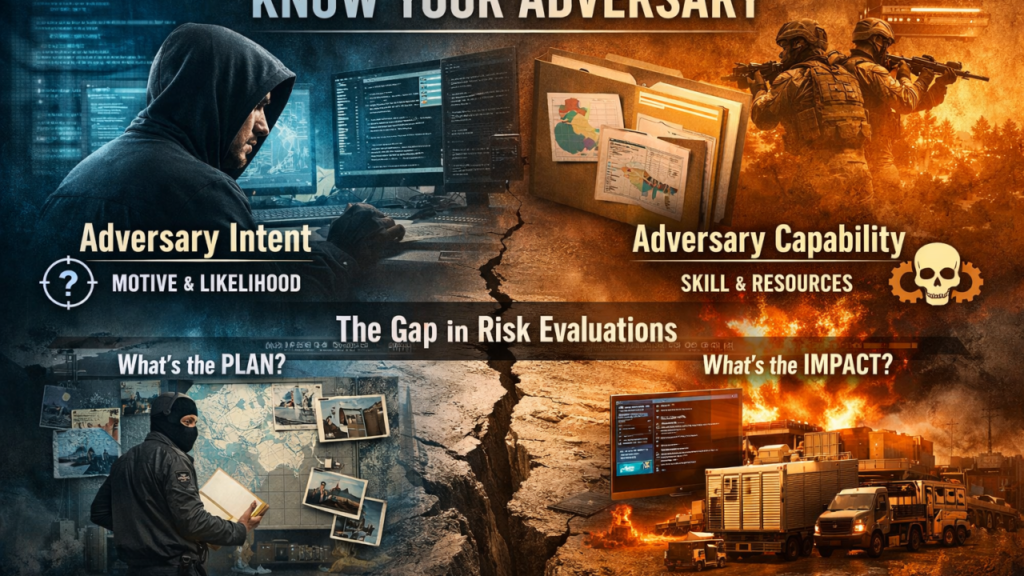
Risk management frameworks across industries have matured significantly over the years. Organisations today invest substantial effort in identifying assets, cataloguing vulnerabilities, and implementing layered controls. Despite this, major security incidents, ranging from insider sabotage and cyber compromise to physical and supply chain disruptions continue to occur with alarming regularity.
A common root cause underpins many of these failures is that risk evaluations often focus on 𝘄𝗵𝗮𝘁 needs protection and 𝗵𝗼𝘄 it is protected, while neglecting 𝘄𝗵𝗼 is attempting to compromise it. In fact, 𝘁𝗵𝗲 𝗮𝗱𝘃𝗲𝗿𝘀𝗮𝗿𝘆 𝗮𝗹𝗼𝗻𝗴 𝘄𝗶𝘁𝗵 𝘁𝗵𝗲𝗶𝗿 𝗶𝗻𝘁𝗲𝗻𝘁 𝗮𝗻𝗱 𝗰𝗮𝗽𝗮𝗯𝗶𝗹𝗶𝘁𝘆 remains the most decisive factor in how risk materialises. When this dimension is overlooked, risk assessments become theoretical exercises rather than reliable decision-support tools.
𝗧𝗵𝗲 𝗔𝗱𝘃𝗲𝗿𝘀𝗮𝗿𝘆 𝗮𝘀 𝘁𝗵𝗲 𝗖𝗲𝗻𝘁𝗿𝗮𝗹 𝗥𝗶𝘀𝗸 𝗩𝗮𝗿𝗶𝗮𝗯𝗹𝗲
Every incident is the outcome of deliberate human action. Whether the threat originates from an insider, an organised criminal group, or a sophisticated cyber actor, the event is shaped by the adversary’s motivation, persistence, resources, and access. Yet many organisational risk models continue to treat threats as static, generic, or abstract.
This abstraction creates a dangerous disconnect between documented risk postures and real-world exposure. Effective risk evaluation must therefore begin with a clear understanding of credible adversaries and their evolving characteristics.
𝗔𝗱𝘃𝗲𝗿𝘀𝗮𝗿𝘆 𝗜𝗻𝘁𝗲𝗻𝘁 𝗮𝗻𝗱 𝘁𝗵𝗲 𝗠𝗶𝘀𝗰𝗮𝗹𝗰𝘂𝗹𝗮𝘁𝗶𝗼𝗻 𝗼𝗳 𝗟𝗶𝗸𝗲𝗹𝗶𝗵𝗼𝗼𝗱
Intent is the most frequently overlooked determinant of likelihood. It governs whether an attack will occur at all and how persistently it will be pursued once initiated.
Consider the case of a disgruntled employee with privileged system access. A conventional assessment may rate the risk as low due to strong access controls, monitoring systems, and compliance with internal policies. However, once dissatisfaction escalates into grievance or perceived injustice, the probability of malicious action increases sharply. At this stage, baseline controls offer limited predictive value because likelihood is no longer driven by control design but by human motivation.
A similar pattern emerges in organised external threats such as cargo theft or supply chain diversion. These adversaries do not act randomly. Their intent is shaped by market demand, route predictability, intelligence availability, and perceived enforcement gaps. When these factors align, attacks become planned, targeted, and repeated rather than opportunistic.
Without explicitly assessing adversary motivation which is usually shaped by financial drivers, ideological factors, personal grievances, or coercion; likelihood ratings remain speculative and often dangerously understated.
𝗔𝗱𝘃𝗲𝗿𝘀𝗮𝗿𝘆 𝗖𝗮𝗽𝗮𝗯𝗶𝗹𝗶𝘁𝘆 𝗮𝘀 𝘁𝗵𝗲 𝗧𝗿𝘂𝗲 𝗗𝗿𝗶𝘃𝗲𝗿 𝗼𝗳 𝗜𝗺𝗽𝗮𝗰𝘁
While intent determines whether an incident will occur, capability determines how severe its consequences will be. Capability encompasses technical skill, access levels, insider knowledge, financial resources, and organisational sophistication.
A low-capability actor may cause superficial disruption, such as website defacement or minor theft. In contrast, a well-resourced and knowledgeable adversary can compromise data integrity, disrupt operations across multiple locations, or bring entire supply chains to a standstill.
This distinction is evident across threat domains. In cyber incidents, advanced actors frequently bypass perimeter defences by exploiting valid credentials rather than deploying malware. Insider threats leverage authorised access, rendering many traditional security controls ineffective. In physical security breaches, attackers exploit routine behaviour, complacency, and procedural weaknesses rather than brute force.
Impact assessments that ignore adversary capability routinely underestimate worst-case scenarios and leave organisations unprepared for systemic disruption.
𝗖𝗼𝗺𝗺𝗼𝗻 𝗙𝗮𝗶𝗹𝘂𝗿𝗲𝘀 𝗶𝗻 𝗢𝗿𝗴𝗮𝗻𝗶𝘀𝗮𝘁𝗶𝗼𝗻𝗮𝗹 𝗥𝗶𝘀𝗸 𝗘𝘃𝗮𝗹𝘂𝗮𝘁𝗶𝗼𝗻𝘀
Many risk registers and enterprise risk assessments continue to rely on assumptions that no longer reflect the operating environment. These typically include static threat levels, generic threat actor categories, and control effectiveness ratings that do not account for adversary sophistication.
Such assumptions create a false sense of assurance. Organisations may score highly on audits and compliance reviews while remaining poorly prepared for targeted, adaptive attacks. A high-intent but low-capability individual may still cause catastrophic harm through impulsive or violent action, while a highly capable actor with low current intent represents a latent threat that can materialise rapidly when conditions change.
Risk is dynamic, and adversaries evolve continuously. Treating them as static or interchangeable fundamentally weakens risk evaluation.
𝗘𝗺𝗯𝗲𝗱𝗱𝗶𝗻𝗴 𝗔𝗱𝘃𝗲𝗿𝘀𝗮𝗿𝘆 𝗖𝗲𝗻𝘁𝗿𝗶𝗰 𝗧𝗵𝗶𝗻𝗸𝗶𝗻𝗴 𝗶𝗻𝘁𝗼 𝗥𝗶𝘀𝗸 𝗘𝘃𝗮𝗹𝘂𝗮𝘁𝗶𝗼𝗻
To address these shortcomings, risk professionals must adopt an intelligence-led, adversary-centric approach. This requires moving beyond generic threat statements and explicitly integrating adversary intent and capability into risk assessments.
Practical steps include profiling credible threat actors relevant to the organisation’s sector and operating context, adjusting likelihood ratings when indicators of intent increase, and stress-testing controls against high-capability adversaries rather than average-case assumptions. Continuous monitoring of changes in motivation, access, and resources is equally critical, particularly in insider risk and supply chain environments.
When adversary dynamics are systematically embedded into the risk process, risk management evolves from a documentation-driven activity into a strategic tool that informs leadership decisions and resource allocation.
𝗖𝗼𝗻𝗰𝗹𝘂𝘀𝗶𝗼𝗻
Security controls rarely fail in isolation. More often, failure begins with flawed assumptions about the adversary. When organisations do not understand who is targeting their assets and why, risk evaluations lose operational relevance and become instruments of compliance rather than protection.
Modern risk leadership demands a shift toward intelligence-driven, adversary-aware risk management. It reflects how incidents actually occur rather than how policies assume they should not. Only by recognising the central role of adversary intent and capability can organisations produce risk evaluations that are credible, actionable, and resilient in an increasingly complex threat landscape.